Choosing a garden machinery manufacturer in China is a decision you will live with for two or three seasons. The machine itself is only half the risk: the other half is whether that factory can hold a tolerances, hold a delivery date, and still be answering the phone when a warranty claim lands eighteen months later. This checklist is built for importers, distributors and private-label buyers sourcing petrol powered tools in bulk.
Related reading: before you start comparing factories, it helps to be clear on MOQ, lead time and payment terms when sourcing garden machinery from China, because those commercial terms usually narrow the shortlist faster than any technical question.
1. Separate the factory from the trading company
Both models can work, but they fail in different ways. A genuine factory owns the assembly line, the test rig and usually the engine supply contract with its own capital. A trading company offers breadth and flexibility, but discovery visits, engineering changes and claim resolution all take an extra hop.
- Ask for the business licence and check whether “manufacturing” appears in the registered scope.
- Ask who owns the tooling for the mower deck or the chainsaw housing. Tooling ownership decides whether your private-label mould can be moved to another supplier.
- Ask for the production schedule of the current month. A factory can describe a running line; a trader describes a calendar.
2. Audit the three things that actually break
In warranty data across our own models, roughly three quarters of claims trace back to three components, not to the big visible parts.
| Sub-system | Failure mode in the field | What to ask the factory |
|---|---|---|
| Starting system | Cold start failure after storage | Carburetor brand, primer bulb supplier, and starting test at low temperature |
| Cutting drive | Blade adapter loosening, shaft twist, clutch slip | Clutch supplier, shaft spline hardening method, torque test records |
| Fuel system | Ethanol-related hose and gasket swelling | Hose and gasket material spec against E10 fuel |
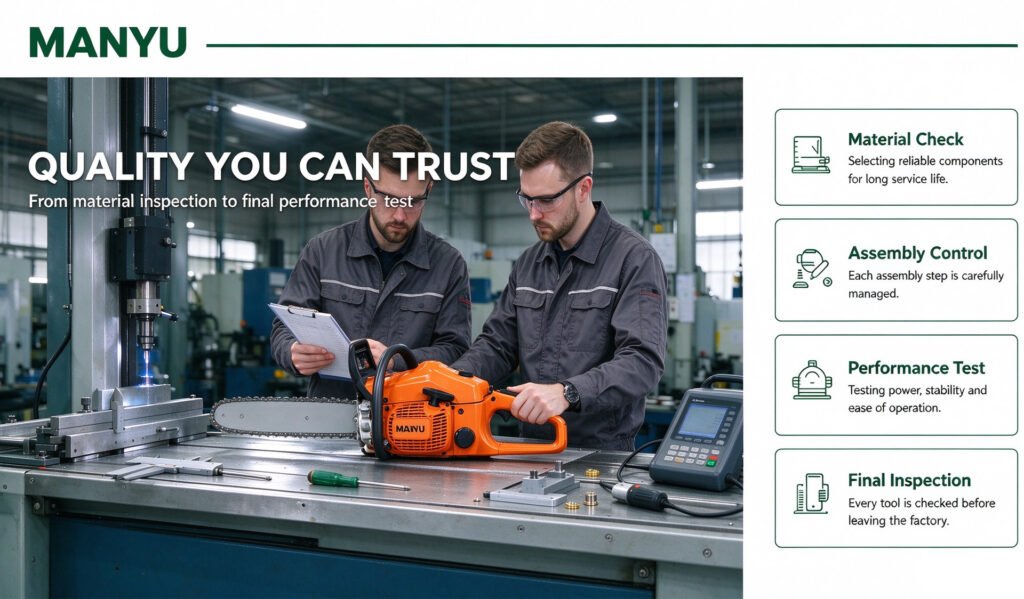
A serious supplier can show you test records for each row. A supplier that answers every question with “all our machines are CE certified” is not answering the question.
3. Buy or make: where do the engines come from?
Most petrol garden machinery plants do not cast their own two-stroke engines; they buy from an engine maker and tune the intake, exhaust and mounting. That is normal. What you need to know is whether the engine supply is contractually locked, because that decides two very commercial things:
- Emissions compliance stability — if the engine supplier changes carburetor calibration without notice, your CE, EPA and Euro V documentation can fall out of step with the physical product.
- Repeat-order consistency — same engine model, same mounting points, means your own spare parts inventory stays valid across shipments.
4. Check the export track record, not the exhibition stand
Ask for shipment history to your own region. A factory that has shipped to the EU for five years already understands packaging warnings, documentation language requirements and the practical reality of how a distributor handles a defect claim. A factory shipping for the first time to your market will learn those lessons on your first container.
5. Ask what happens when something goes wrong
This is the question that best predicts the relationship. A manufacturer with an after-sales system will be able to answer immediately: what defect rate is considered normal, what is the claim window, who pays the freight on warranty parts, and what information they need to process a claim (serial number, photo, video). We cover this in detail in spare parts and after-sales: what decides repeat orders.
Quick FAQ
Should I use an inspection agency? For your first order with any new supplier, yes. Third-party pre-shipment inspection typically costs a fraction of a single container’s margin and gives you a documented defect rate to negotiate from.
How many suppliers should I keep? Two qualified suppliers per core category is realistic. One source for your volume good-better-best models, one qualified backup you can activate within one season.
Is a factory audit trip worth it? For annual spend above roughly USD 200,000, a two-day visit pays back in both specification accuracy and negotiation position.
Next step
Start from the range, not from a single machine. Browse the four export categories — lawn mowers, chain saws, trimmers and cutters, leaf blowers — and note which specifications your own market asks for most. Then send us the shortlist on our contact page and we will quote against it line by line.